What is Chemical earthing
Chemical Earthing Electrode
Table of content
- Introduction to Chemical Earthing
- Chemical Earthing Design
- Types of Earthing.
- Which Chemical used in earthing.
- Chemical Earthing Specification Characteristic quality to be checked
- Which Material is best for earthing
- Which Type of earthing is more efficient.
- What are the four types of earthing as per IEC 60364.
- How to achieve earth resistance below 1 ohm
- Method to reduce Earthing electrode resistance.
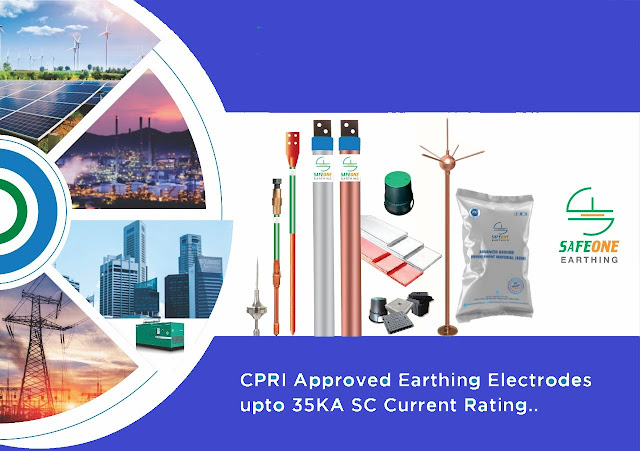
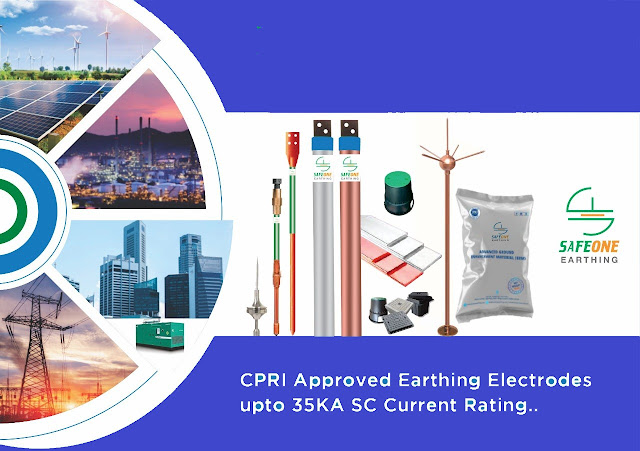
- CPRI Tested Earthing Rod up to 35KA
- chemical earthing Specification and Types.
- GI Earthing rod.
- Pipe in Pipe Earthing rod.
- Pure copper earthing rod.
- Solid Earthing rods Copper Bonded.
- Copper Bonded Pipe Earthing rod.
- Chemical earthing Price.
- Advantages of chemical earthing as compared to conventional earthing
- Application of Chemical Earthing
- Chemical Earthing Installation.
- Chemical Earthing Material
- Testing of Chemical Earthing.
- chemical Earthing Diagram Drawings
- Difference Between Chemical Earthing and Conventional Earthing
Introduction to Chemical Earthing
Chemical Earthing rods are used for electrical systems in earthing applications
in this earthing ground enhancement compound is used while the conventional earthing uses salt and charcoal.
Ground enhancement compounds are excellent Earthing Design conductive compounds.
It is a mixture of bentonite graphite and Carbon compounds also called chemical earthing compound or backfill compound (BFC).
Mixed with water forming a paste which is poured in the earth pits. These compounds surround the electrode.
Surrounding the Electrode with BFC increase the ground rod's surface area and decreasing ground resistance.
Ground enhancement compounds are widely used for poor soil conductivity in Rocks and mountain areas.
This compound is highly conductive, which reduces the resistivity of ground and helps in quick discharge of fault current.
Chemical earthing rods are maintenance free earthing which does not require any water during the complete life span of earthing rod.
This earthing has a long life as compared to conventional earthing and is very easy to install. The ohmic value is retained that is not changed throughout its useful life.
Chemical Earthing Design
This depends on proper selection of earthing rod such as diameter and length of rod and the number of Earthing's required for reducing the resistance of the rod.
Soil resistivity test can also be performed for proper design of earth rods this test also helped for finding resistivity of soil in ohm meter.
The number of earthing rods depends upon the electrical load, short circuit fault current of the system and soil resistivity of the ground. Soil resistivity of ground depends upon moisture content and temperature of ground.
Earthing design calculation is done as per standards below IS 3043 IEC standard IEC 60364 and BS7430 Design Parameters & Formula IS-3043 As per 10.3 of IS: 3043.
The current density permissible at the earth electrode is given by. Id = 7.57*10³/√(ρ*t) Amps/m² ρ – resistivity soil t – fault clearance time Resistance in ohms of the plate type electrode is given by R =ρ/4 * (π/A) Ω. Were, A – total area of the earth electrode.
The Fault current which occurs in the electrical system must be discharged to the earth safely and quickly to avoid electric shock.
Chemical earthing electrodes have a very low resistance to earth and can discharge the fault current very quickly in a short time.
Made with excellent quality of mild Steel material and coated 100-250 microns with zinc or copper. This earthing rod is filled with backfill compound to discharge the current safely.
The Best Earthing protection for the system should be provided by earthing systems that are designed to ensure proper earthing in accordance with the standards
Types of Earthing
Pipe earthing
Plate Earthing
Solid Rod earthing
Which Chemical used in earthing
There are numerous available mixtures used in chemical earthing this are carbon based, or bentonite based with a mixture of graphite and other compounds
Conductive cement is also present in some compounds. after installation it hardens into a concrete that does not mix with the ground and is not washed out.
Chemical Earthing Specification Characteristic
Quality To be Checked
Chemical earthing compound should have high conductivity.
Should Maintain Constant Earth Resistance with Time.
Should Be Non-corrosive in nature.
Should not mix with earth as it should be firm and separate.
It should not decompose dissolve with Time.
It should not pollute the soil
Which Material is best for earthing
Copper is the material of choice for grounding but is not often used due to its high cost.
Stainless steel rods are also used for earthing purpose Mild steel which is galvanized and most cost effective used in earthing systems.
Copper bonded earthing's are most commonly used and are a good replacement of pure copper earthing electrodes. They are most commonly used in replacement of pure copper
Which Type of earthing is more efficient
Copper bonded strip in pipe earthing rod Commonly used in buildings, factories, CNC and printing machines.
A copper bonded strip in the pipe of larger-diameter and pipe 3m long ought to have a voltage between neutral and ground
less than 3V for optimal performance, due to their low resistance.
What are the 4 types of earthing as per IEC 60364
TN-C System- Neutral and protective conductor are combined
TNS Neutral and Protective Conductor Both are separate
TT System- equipment's are directly earthed the supply system neutral has no connection
IT System- Isolated System No direct connection to ground
How to achieve earth resistance
below 1 ohm.
Method to reduce Resistance of electrode.
1) Increasing the surface area of the rod by length and diameter
2) Deeply driven inside the ground up to 3 meters or above
have a great impact in reducing the resistivity of ground
for better result.
3) Interconnection between 2 or more rods gives lower resistance.
4) Higher size of conductor to be used from Earthing Electrode to
Equipment Earthing.
5) Soil treatment to be done by using high quality backfill
compound Earth resistance normally depends upon soil
conditions which must be improved through proper design
6) Quality of Electrode Check for availability of Earthing Strip inside
pipe electrode.
Quality of Installation also play a vital role for reducing the electrode
Resistance. to achieve these following below points shall be considered
1) Backfill compound should be Poured Properly
so that it cannot mix with Ground it should surround
the electrode firmly and act as a metal further to reduce
the resistivity.
2) Higher size of Hole diameter minimum Diameter 100mm this will
accumulate more Backfill compound helping to
reduce the resistivity.
3)Connection of Earth Electrode with Conductor should be
properly Connected with no loose connection
Quality of installation also Play a avital role for reducing the electrode Resistance.
the backfill compound should be poured Properly so that it should surround the
electrode firmly and act as a metal further to reduce the resistivity.
CPRI tested Earthing Rod up to 35KA.
Safeone Make Tested Earthing Electrode
GI strip in pipe earthing electrode with a diameter of 76mm was tested for 35KA RMS 1 second and 70KA Peak.
GI strip in pipe earthing electrode 48mm diameter tested for 20KA RMS 1 second and 44KA Peak.
Copper bonded strip in pipe electrode 48mm diameter tested for 25KA RMS 1 second and 50KA Peak.
Chemical earthing Specification and Types.
GI earthing rod
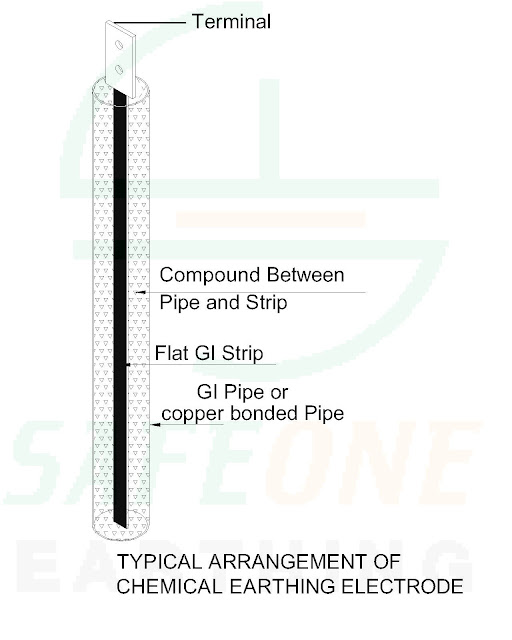
Strip in pipe earthing rod
Pipe in Pipe earthing rod
Pure copper earthing rod
Copper bonded Solid earthing rod
Copper bonded earthing
GI Earthing Rod
Galvanized iron earthing rods (GI) are zinc coated that helps to prevent corrosion.GI earthing rods are most economical and widely used.
Strip in pipe earthing rods are electrodes having pipe with GI strip inserted inside the pipe at the top of the strip terminal are welded to which earthing strip is connected.
Pipe in Pipe Earthing
Pipe in pipe earthing rods have an inner pipe surrounded by an external pipe.
These rods are very robust in construction Dual pipe increases the surface area of the rod capable of withstanding heavy short circuit current.
The inner pipe is covered by the outer pipe and is not exposed to the outside soil or in direct contact, so it will not rust. Filled with conductive compound between pipes to withstand heavy short circuit current.
Can be customized as per requirement. Sizes available 50mm and 80mm length 1/2/3 metre
Pure Copper Earthing Electrode
Pure copper earthing rods are available in solid electrode or plate type.
They are much more costly than GI or copper bonded rods.
Mostly used in high corrosive environments.
Also used in Production Factory.
These rods are lifetime once installed properly.
Solid earthing rod is light in weight and easy to install V clamp or T clamp welded on top for earthing strip connections.
The V clamp has 4 holes, and the T clamp has 2 holes on both sides of the clamp for strip connections.
Copper coated on MS material up to 100 to 250 microns
Solid earthing rods can be driven deeply by using a coupler up to 3-6-9 mtr or deeper using a coupler on both ends of the rod.
This earthing can be customized as per the requirement
Sizes available 14.2/17.2/25/32mm length 1/2/3 metre.
Copper Bonded Pipe Earthing Rod
Copper bonded earthing rods are coated with a copper layer. that increases the conductivity and the life of earthing, it also increases the current carrying capacity of fault current.
Sizes available 50mm and 80mm length 1/2/3 metre
Copper plating with thickness of 100 to 250 microns.
Chemical Earthing Price
Depends upon length and diameter of electrode and Type
Commonly used and minimum price of GI earthing electrode for Diameter 50 mm length 3 mtr electrode will be around 1200 to 1500/-Rs copper bonded same size 1600-1800/-Rs.
Prices also depend on minimum order quantity to maximum order quantity and Quality of material
Advantages of chemical earthing as compared to conventional earthing.
Easy to install: - installation is very easy as compared to conventional Earthing as it is installed by machine or manually by creating a hole of Diameter 100-125mm Since the chemical earthing electrode has lesser width (Diameter) Then conventional earthing which is 300x 300mm or 600 x 600mm Plate to install this plate a larger area of soil required to be excavated but in chemical earthing only round 100-125mm hole to be provided for installation this makes the installation fast with less manpower reducing the cost and time with quality earthing system
More safety: - Safety of chemical earthing is Superior then conventional earthing since it has high with stand capacity to discharge the fault current in less duration of time it also provides constant earth resistance value in long time because of copper bonding and zinc coating which protect from rusting and disconnection of earthing system.
Maintenance free:- Chemical earthing are maintenance free because it does not required water for maintenance as compared to conventional earthing the backfill compound used doesn't mix with soil, so the value of earthing remains the same the back fill compound act as a metal rod and no need for watering as it doesn't dissolved in soil as compared to conventional earthing were salt and charcoal used dissolved in soil after some time
No water required: - No water is required for chemical earthing as the backfill compound act as metal surrounding the earthing electrode
which maintains the earthing value constantly hence no need to put the water if the BFC compound has been settled down after some years it is advisable to recharge the pit with backfill compound instead of putting water.
Good conductivity: - Chemical earthing has an excellent conductivity as compared to conventional earthing when properly installed with backfill compound the backfill compound surrounds the electrode firmly which increases the area of earthing electrode results in increasing the conductivity and also to withstand high short circuit current.
Less space required: - Chemical earthing are space efficient as it has lesser width than conventional earthing it can be derived vertically inside the ground as per our requirement up to 3 to 6 metres due to this advantages it can be used efficiently where there is a space limitation
Low resistance: - Chemical earthing has lesser ohms value than conventional earthing some CNC machine Panel, Printing Press Machine and Sophisticated electronic panel need a neutral and Earthing voltage below 2 Volt which is hard to achieve and only possible with lesser ohms value of earthing electrode Mostly this can be achieved by installing chemical earthing as they have a very low resistance to earth when installed along with BFC Compound
Long life: - Chemical Earthing has long span of life when the material is selected properly copper bonded rods and GI Rods are most commonly used in both cases coating is done on base material which avoids rusting and increases the life of electrode Stainless steel and pure copper can also be used for more longer life.
Withstand heavy fault current: - Chemical earthing has the capability to withstand heavy current as the BFC compound helps the electrode
For discharging high current in less time duration this is possible when the BFC compound is properly surrounded with electrode which acts as a metal resulting increase of surface area creating good conductivity for efficient discharge of fault current
Constant Earth Resistance Value: - Chemical earthing provides constant resistance value for many years as it doesn't use salt and charcoal for increasing the earth resistance since the salt and charcoal mix with soil and reduces the earthing resistance after some time but in case of chemical earthing BFC compound reattains for long time which helps the Earth electrode resistance value for long Time.
Application of Chemical Earthing
Panel room.
Meter room.
CNC machine.
Transformers.
Electrical equipment.
Residential buildings.
Commercial buildings.
Lightning Arrester.
Factories.
Warehouses.
Electric Power Distribution System.
Overhead lines
Substation.
DG SET
Telephone Tower.
Railways
Power lines
IT server.
Rooftop Solar.
Data center
Chemical Earthing Installation.
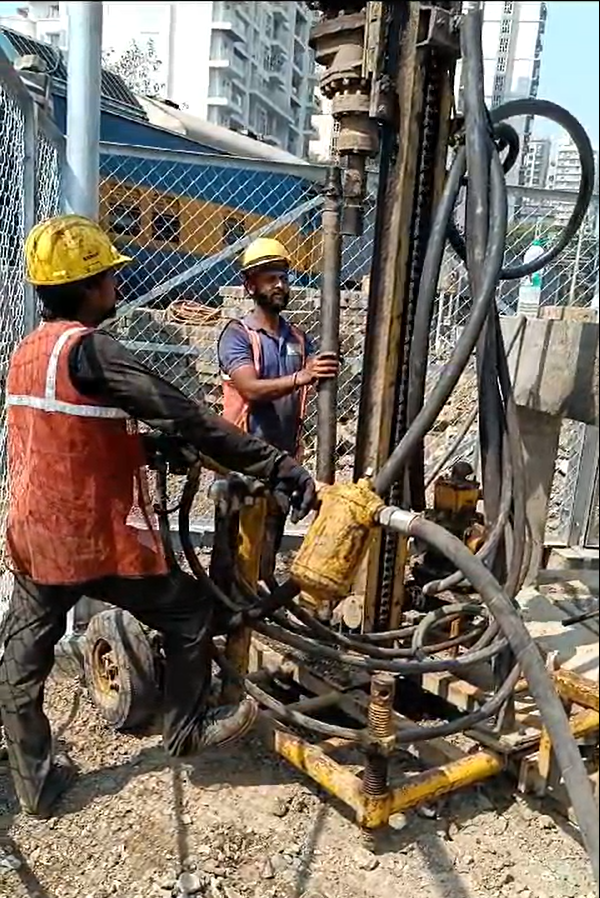
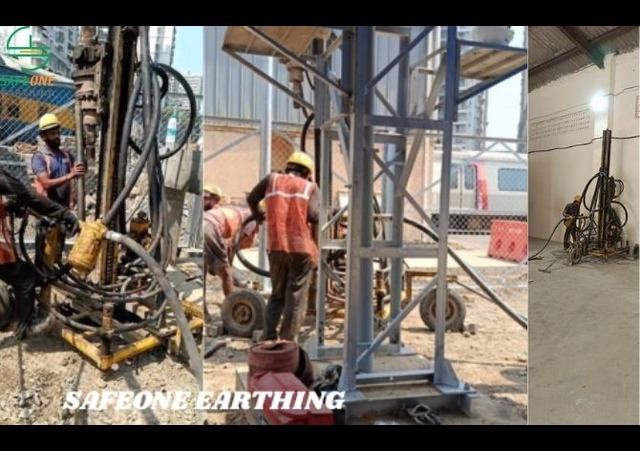
A boring machine is used to install chemical earthing tripod is used for drilling
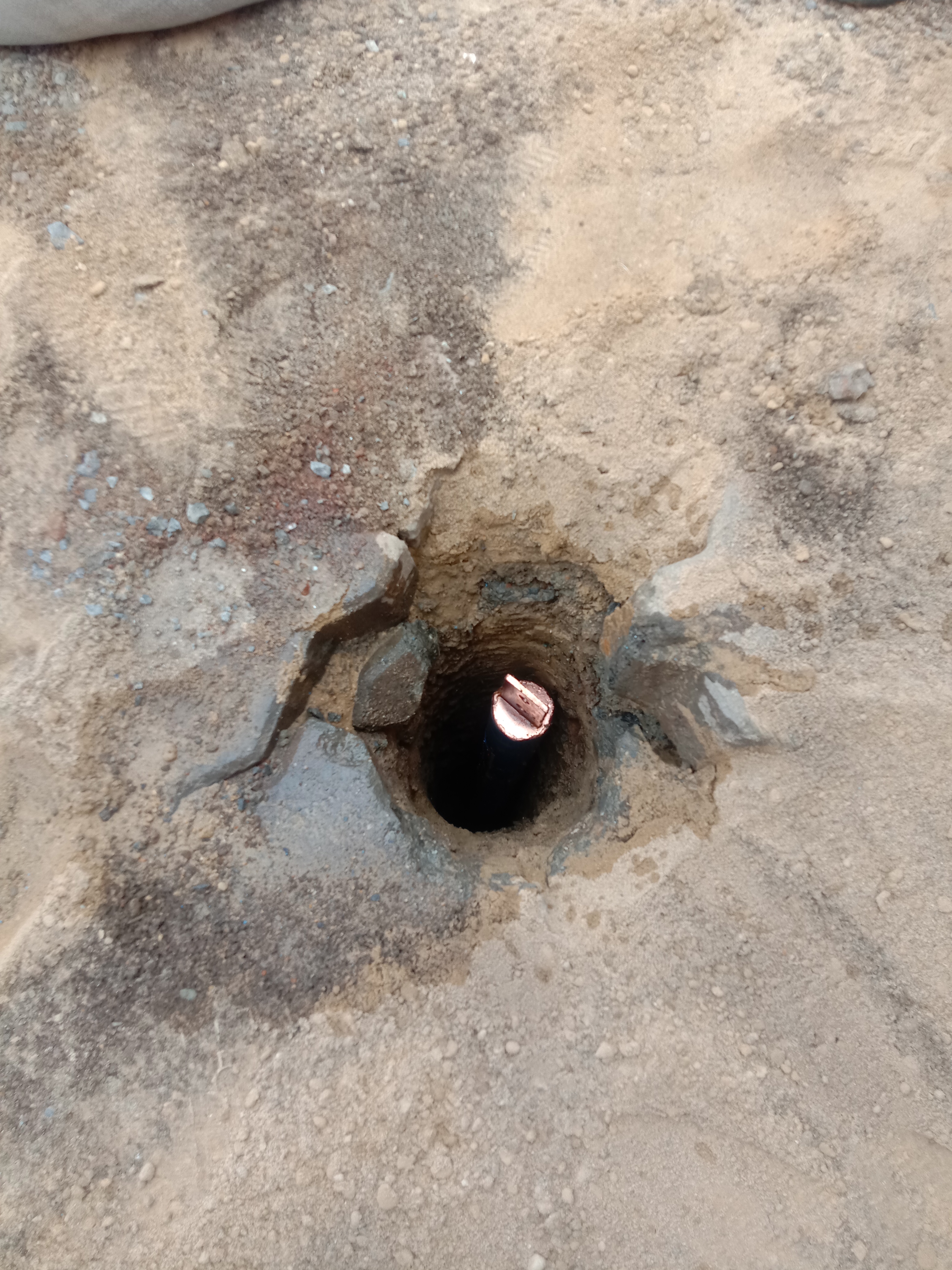
Hole of diameter 100-125mm is to be done by the machine, length of bore below the ground should be done according to the rod length.
After the drilling has been done earthing rod is inserted inside the bore.
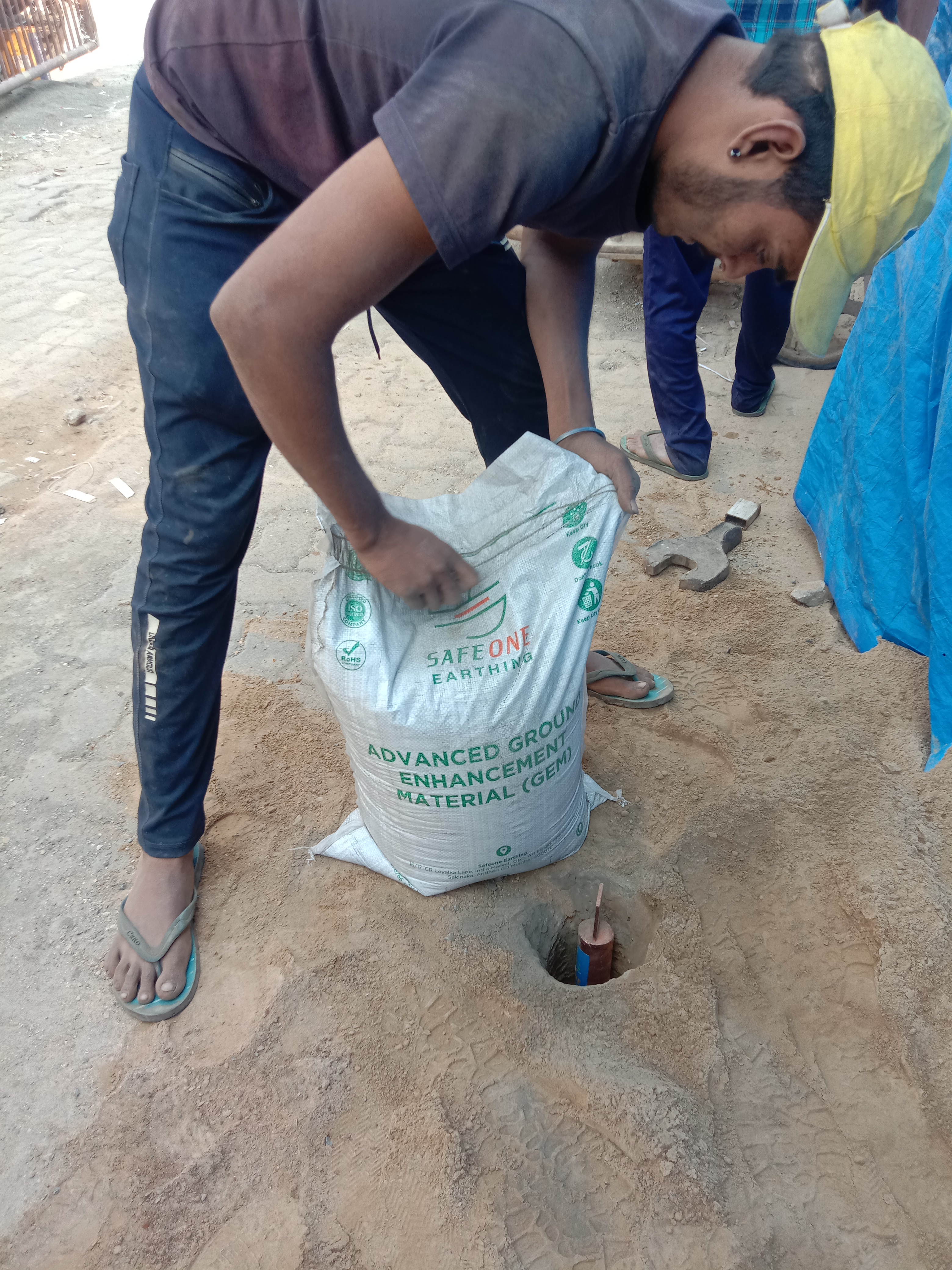
After the earthing rod is installed, it is backfilled with earth enhancement compound along with water forming a paste and poured into the bore hole.
This mixture is poured into the bore until the space between the rod and bore area is filled with compound.
Manual installation can be done if the length of rod is 2mtr or less.
Chemical Earthing Material
For installation of Chemical Earthing Following Material Is Required
Earthing Electrode
Backfill Compound
Earthing Chamber
Earthing Strip
Nut Bolts for Connecting Earthing Strip to Earthing Electrode
Testing Of Chemical Earthing
Testing for existing Earth pit is essential once in a year to check the resistivity of earthing if the earthing resistivity is high any fault occurs in the system Creates Fault Current.
This Fault current may not be discharged quickly if earthing is weak or not properly done hence possibility of system failure is there to minimize unwanted shut down it’s a good Practice to have yearly checking of your earth pits.
Testing for earthing rod is done using earth resistance tester.
3-point testing method are most commonly used.
Rod P1,E2,P2 has to be driven inside the ground with the same distance between them along with the installed or existing rod to be tested. earthing has a good path for flow of heavy current and less resistance to the ground in case of fault current Which protects the system from breakdown.
Our expert team provide testing services for all types of earthing with testing reports further to ensure that your system works properly.
Chemical earthing Diagram Drawings
Description Of Electrode | Download Drawing |
Chemical Earthing Electrode Drawings |
Difference Between Chemical Earthing and conventional earthing
| Chemical earthing | Conventional earthing |
| Less space required | More space required |
| Easy to install with less manpower | Installation required more manpower |
| Long life 12-15 years | Life 6-7 years |
| Backfill compound such as graphite, bentonite used to reduce the resistivity of ground | Salt and charcoal used to reduce the resistivity of ground |
| The earth enhancing compound has no corrosion effect on earthing rod during complete life span | Salt used will have corrosion effect on rod during the period of time |
| Can be driven deeply to ground with jointing coupler 6 to 9 metre or above | Can be installed not more than 3 mtr |
| Low earth resistivity of rod is maintained for complete life span | Resistivity of Plate changes according to age |

What Is Lightning Arrester and its application